
Juhsung: Difference between revisions
No edit summary |
m (1 revision imported) |
(No difference)
| |
Revision as of 00:07, 15 October 2025
 Starting position | |
| Years active | At least 3000 BNB |
|---|---|
| Genres | Board game, Abstract strategy game |
| Players | 2 |
| Skills | Tactics, Strategy |
| Related games | |
| Jashunga, Lhu fum | |
Juhsung (or jushung, 桌戰 "table battle," Classical Nanai: dʑuX ɕwuŋX, Du Nanai: Jux Hsungx /tɕu˩˧ ɕuŋ˩˧/) is a nanai board game, and the ancestor of all varieties of men. It is styled after a battle between opposing generals (the royal pieces), and the names of the pieces reflect this, being based on infantry ranks. The objective is to either bare the opponent's general (i.e. capture all pieces except it) or to humble (checkmate) it.
Rules
Pieces
Each piece in juhsung moves in a specific manner
General
The general (將 dætX) is the game's royal piece, i.e. it must be protected at all costs. It moves one tile in any direction. Capturing the general or baring it ends the game. Most sets mark the general with a character, usually butterfly (蝶 læ) for the white general and crab (蟹 paitH) for the black general. As such, the names for either side, traditionally, are the butterfly squadron (蝶軍 læ dʌpX) and the crab squadron (蟹軍 paitH dʌpX).


Minister
The minister (士 tɕamX) may move one tile orthogonally or leap (over pieces) two tiles diagonally.


Sergeant
The sergeant (帥 gɑk) moves one tile orthogonally.


Archer
The archer (箭 maŋH) may move diagonally up to two tiles. Given their movement, both archers are bound to tiles in alternating order.


Chariot
The chariot (車 raŋH) may move orthogonally up to two tiles.


Soldier and Marshal
The soldier (兵 ɳe) is the most restricted piece. It moves one tile forward. Once it has left its initial position, it may only capture by moving one tile along its rank. Once it reaches the opponent's first rank, it may be flipped over and promoted to the marshal (官 bʊkH). The marshal moves like the general, one tile in any direction.


-
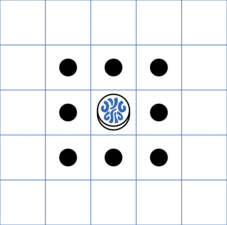
General
-
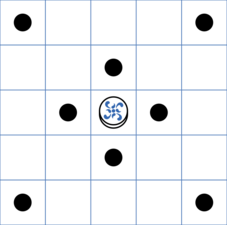
Minister
-
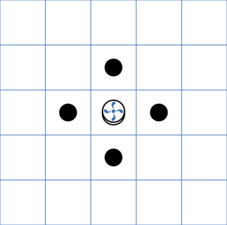
Sergeant
-
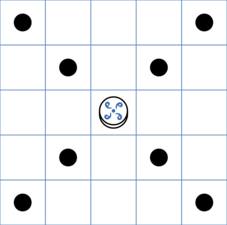
Archer
-
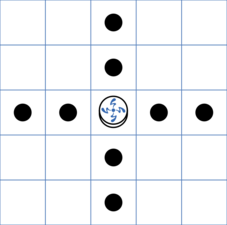
Chariot
-
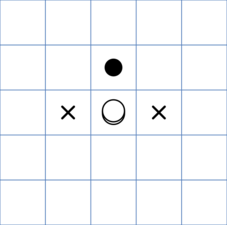
Soldier
-
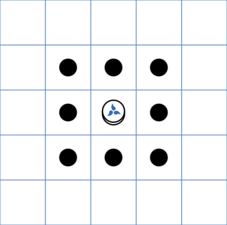
Marshal


