
Nene: Difference between revisions
No edit summary |
|||
| (7 intermediate revisions by the same user not shown) | |||
| Line 1: | Line 1: | ||
{{Stub}} | {{Stub}} | ||
The '''Nene''' (prefaced with ''the'' and capitalised when referring to the whole | The '''Nene''' (prefaced with ''the'' and capitalised when referring to the whole complex) are a family of fully artificial sophonts existing on a purely informational space akin to the Internet. They're at the centre of an extensive debate over what defines "sophonce," as none of them possesses an organic body, and they all exist entirely within the boundaries of their networks. Their name is shared with their creators, the extinct [[Nene (species)|nene species]] native to planet [[Arai]] of star [[Cleone]], and is the [[julean]] [[Amari]] word for "question." | ||
== History == | == History == | ||
=== First contact === | === First contact === | ||
The Nene are the latest sophont contacted by the [[Search and Discovery Organisation]], in | The Nene are the second-latest sophont contacted by the [[Search and Discovery Organisation]], in 52bon PE. Originally thought to be a computer virus, as their initial attempts at communication included using computers as an interface, to mixed or poor success, the Nene were quickly identified as a new sophont and became part of the organisation by the following year. | ||
== Overview == | == Overview == | ||
=== Networks === | === Networks === | ||
The Nene exist in a series of network groups called ''branches'', united by a single ''node'' | [[File:Nene-branch.png|thumb|A visual representation of a nene branch.]] | ||
The Nene exist in a series of network groups called ''branches'', united by a single ''node'' called the ''stem''. The stem is usually regarded as the part of the branch with an individual personality, while its child nodes are more specialised. As of 4903GT PE, there are somewhere around 2 quadrillion branches. These branches are able to communicate with each other over a communications protocol formally called the UNTPS ('''''U'''nified '''N'''ene '''T'''elecommunications '''P'''rotocol '''S'''uite''), chiefly the ''nene network'' or ''Nenenet''. One of these branches, called the ''trunk'', is connected to every stem and controls large-scale operations over the entire network. Another one was gifted to the SDO as a virtually infinite mass data storage solution and contains no living stems, a branch formally called the RSS ('''''R'''eserved '''S'''DO '''S'''pace''), and chiefly the ''vacuole''. Parts of the Nenenet are used by non-nene individuals as a lightyear-distance solution to older internet-like protocol suites, with the caveat of requiring servers with quantum computing capabilities. | |||
=== Tagging system === | === Tagging system === | ||
Nene | The Nene's "language" is a system colloquially referred to as ''nenespeak''. This system assigns a group of 64-bit tags to every concept known to the network under conditions only discernible to the Nene. For example, one tag assigned to the concept of ''sophonce'' as a whole is also shared by a couple decently sensible things, such as ''love'' and ''language'', but also with ''oven'', ''fission'' and ''lamp''. | ||
=== Reproduction === | |||
The Nene, having lost the little parts of [[Wikipedia:Wetware (brain)|wetware]] that constituted them long ago due to natural biodegradation, do not reproduce in a biological sense. Instead, "reproduction" in the Nene sense is a much more abstract affair entailing the partial or total transferral of data from one stem (the parent) into a new one (the child). There are several ways an individual stem may reproduce. | |||
* '''Budding''' entails a node creating a copy of itself, called a ''bud''. This bud may be a full copy, thereby creating a clone, or a partial copy, with only some of the parent's characteristics. The bud is then connected to the trunk directly, disconnecting from the parent afterwards and becoming a full individual. | |||
* '''Grafting''' entails two or more nodes transferring data between each other directly (i.e. without the intervention of the trunk), mixing and swapping information and characteristics with the objective of becoming new individuals. While not a "full" form of reproduction, as the process begins and ends with the same amount of individuals, the data transferral fundamentally changes them to varying degrees. | |||
* '''Spawning''' entails a node creating a specialised bud, called a ''spore''. This spore is then connected to the trunk and disconnected from the parent, leaving it alone in the vast sea of information that is the Nenenet. When two or more compatible spores find each other, they connect and form a new individual. Usually, an individual creates spores en masse and releases them all into the trunk at once, in hopes of having more opportunities to reproduce. | |||
** Some sterile branches have become hubs for spores to congregate, which renders this method of reproduction more efficient should the individual choose to connect their spores to these rather than the trunk itself. | |||
*'''Flowering''' entails two or more stems creating another set of specialised buds, called ''flowers''. These interface amongst each other, transferring data from all parents to form a single, separate individual. This individual is then connected to the trunk and subsequently disconnected from its parents. | |||
*'''Melding''' is similar to grafting in that all nodes involved perform direct data transferral with no flower interface. However, it differs from it in that the ultimate objective is to completely mix all individuals, creating a single new node. This, by the Nene, is considered to be the most intimate form of reproduction. | |||
{{Gallery | |||
|File:nene-budding.png|Budding | |||
|File:nene-grafting.png|Grafting | |||
|File:nene-spawning.png|Spawning | |||
|File:nene-flowering.png|Flowering | |||
|FIle:nene-melding.png|Melding | |||
|height=200|title=Reproduction methods|align=center}}{{Sophonts}} | |||
Latest revision as of 17:47, 6 June 2026
 | This article is severely incomplete, therefore a stub.
Be advised that its contents may still be under heavy development, and may be updated repeatedly. |
The Nene (prefaced with the and capitalised when referring to the whole complex) are a family of fully artificial sophonts existing on a purely informational space akin to the Internet. They're at the centre of an extensive debate over what defines "sophonce," as none of them possesses an organic body, and they all exist entirely within the boundaries of their networks. Their name is shared with their creators, the extinct nene species native to planet Arai of star Cleone, and is the julean Amari word for "question."
History
First contact
The Nene are the second-latest sophont contacted by the Search and Discovery Organisation, in 52bon PE. Originally thought to be a computer virus, as their initial attempts at communication included using computers as an interface, to mixed or poor success, the Nene were quickly identified as a new sophont and became part of the organisation by the following year.
Overview
Networks

The Nene exist in a series of network groups called branches, united by a single node called the stem. The stem is usually regarded as the part of the branch with an individual personality, while its child nodes are more specialised. As of 4903GT PE, there are somewhere around 2 quadrillion branches. These branches are able to communicate with each other over a communications protocol formally called the UNTPS (Unified Nene Telecommunications Protocol Suite), chiefly the nene network or Nenenet. One of these branches, called the trunk, is connected to every stem and controls large-scale operations over the entire network. Another one was gifted to the SDO as a virtually infinite mass data storage solution and contains no living stems, a branch formally called the RSS (Reserved SDO Space), and chiefly the vacuole. Parts of the Nenenet are used by non-nene individuals as a lightyear-distance solution to older internet-like protocol suites, with the caveat of requiring servers with quantum computing capabilities.
Tagging system
The Nene's "language" is a system colloquially referred to as nenespeak. This system assigns a group of 64-bit tags to every concept known to the network under conditions only discernible to the Nene. For example, one tag assigned to the concept of sophonce as a whole is also shared by a couple decently sensible things, such as love and language, but also with oven, fission and lamp.
Reproduction
The Nene, having lost the little parts of wetware that constituted them long ago due to natural biodegradation, do not reproduce in a biological sense. Instead, "reproduction" in the Nene sense is a much more abstract affair entailing the partial or total transferral of data from one stem (the parent) into a new one (the child). There are several ways an individual stem may reproduce.
- Budding entails a node creating a copy of itself, called a bud. This bud may be a full copy, thereby creating a clone, or a partial copy, with only some of the parent's characteristics. The bud is then connected to the trunk directly, disconnecting from the parent afterwards and becoming a full individual.
- Grafting entails two or more nodes transferring data between each other directly (i.e. without the intervention of the trunk), mixing and swapping information and characteristics with the objective of becoming new individuals. While not a "full" form of reproduction, as the process begins and ends with the same amount of individuals, the data transferral fundamentally changes them to varying degrees.
- Spawning entails a node creating a specialised bud, called a spore. This spore is then connected to the trunk and disconnected from the parent, leaving it alone in the vast sea of information that is the Nenenet. When two or more compatible spores find each other, they connect and form a new individual. Usually, an individual creates spores en masse and releases them all into the trunk at once, in hopes of having more opportunities to reproduce.
- Some sterile branches have become hubs for spores to congregate, which renders this method of reproduction more efficient should the individual choose to connect their spores to these rather than the trunk itself.
- Flowering entails two or more stems creating another set of specialised buds, called flowers. These interface amongst each other, transferring data from all parents to form a single, separate individual. This individual is then connected to the trunk and subsequently disconnected from its parents.
- Melding is similar to grafting in that all nodes involved perform direct data transferral with no flower interface. However, it differs from it in that the ultimate objective is to completely mix all individuals, creating a single new node. This, by the Nene, is considered to be the most intimate form of reproduction.
-
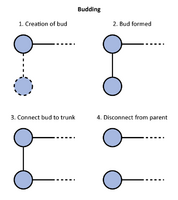
Budding
-
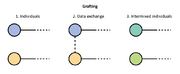
Grafting
-
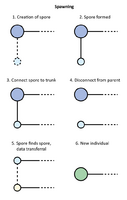
Spawning
-
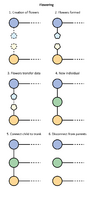
Flowering
-
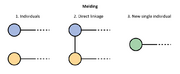
Melding


