
Liuwha
 Starting positions | |
| Years active | At least 100 BNB |
|---|---|
| Genres | Board game, Abstract strategy game |
| Players | 2 |
| Skills | Tactics, Strategy |
| Related games | |
| Juhsung, Lhu fum | |
Liuwha or lhuwha (Bengereite: YluHwN lhuwhã /ʎuˈɸɐ̃/, a loanword from Bahlian) is an abstract strategy board game in the juhsung family originating from Great Vugon, specifically a simplified variant of lhu fum meant to be played with seashells on the sand. The objective, like that of other games in this family, is to humble (checkmate) or bare the general.
Setup
Liuwha is played on a 7×7 board, with the first two ranks on each side being reserved for the pieces' starting positions. Unlike in other games of its family, both sides are completely identical. In order:
- First rank: limpet-oyster-mpiampia-snail-mpiampia-oyster-limpet.
- Second rank: populated entirely by cowries.
Rules
Pieces
Snail
The snail (whito Hwito) is the royal piece and moves one tile in any direction.


Mpiampia
The mpiampia (piampia YpmxYp, a limpet-like mollusc with a star shaped shell) leaps hippogonally (1,2).


Limpet
The limpet (sinó siwhã sinoUU'siHwN) moves one tile diagonally. Once it reaches the first rank of the enemy it may be overturned (ngito sinó siwhã), and move one tile in any direction.


Oyster
The oyster (whuripo Hwuripo) moves one tile orthogonally. It may also be overturned (ngito whuripo) and move the same way as the overturned limpet.


Cowrie
The cowrie (siwhã siHwN) moves only one tile forward. There is no sideways capture like in other juhsung games, so the only way for the cowrie to capture is straight forward. It may also be overturned (ngito siwhã ṅito'siHwN) and move the same way as the mpiampia.


-
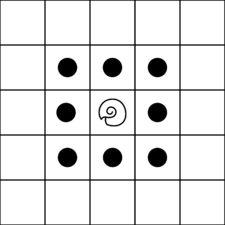
Snail
-

Mpiampia
-
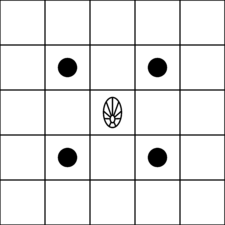
Limpet
-
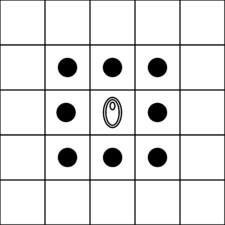
Overturned limpet
-
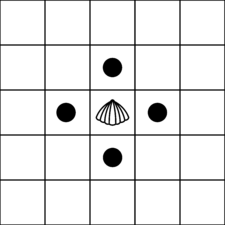
Oyster
-
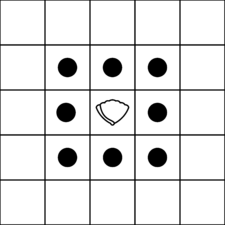
Overturned oyster
-
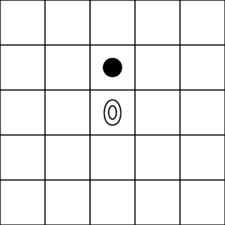
Cowrie
-
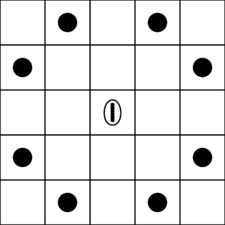
Overturned cowrie


